
Learning to Walk Again: The Long Game of Gait Retraining
For many people living with a spinal cord injury, the question of walking again sits somewhere between hope and uncertainty. Progress rarely happens overnight. It’s built slowly, step by step, repetition by repetition, through a combination of neurological recovery, biomechanics, strength, and persistence.
At Karve Collective, gait retraining isn’t about chasing a single milestone. It’s about developing movement patterns that are sustainable, efficient, and meaningful for the person doing them.
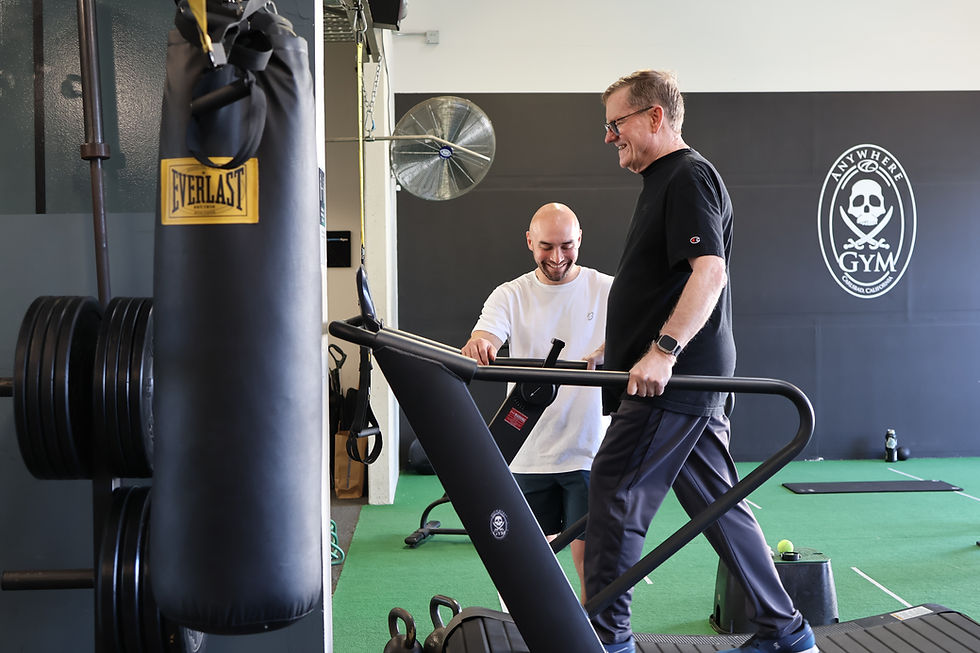
Mike’s journey is a great example of what that process can look like.
Mike’s Story
Mike sustained a C5 incomplete spinal cord injury in 2018. An incomplete injury means that some signals can still travel past the level of injury, but the strength, coordination, and control of those signals can vary greatly.
When we talk about “walking again,” we’re not simply talking about moving the legs forward. Walking is one of the most complex movements the human body performs. It requires:
Coordination between both sides of the body
Dynamic balance
Strength in the hips, glutes, and trunk
Precise timing of muscle activation
The ability to absorb and generate force with every step
For someone with a spinal cord injury, each of these components often needs to be rebuilt and retrained.
Understanding the Biomechanics of Walking
A normal gait cycle has several key phases:
Heel Strike – the foot contacts the ground
Loading Response – body weight transfers onto the leg
Mid Stance – the body passes over the planted foot
Push Off – the back leg generates propulsion
Swing Phase – the leg moves forward to begin the next step
After neurological injury, these phases can become disrupted. Some common challenges include:
Reduced hip extension
Limited push-off power
Knee instability
Foot drop
Asymmetrical stepping patterns
Excessive reliance on assistive devices
If these patterns aren’t addressed, people often develop compensations that allow them to move but make walking inefficient, exhausting, or unsafe.
That’s where targeted gait retraining becomes essential.
Building a Walking Progression
At Karve, walking is approached as a progression of skills, not a single exercise.
Early stages often focus on:
Postural alignment
Trunk and pelvic control
Weight shifting
Hip activation
Controlled stepping patterns
As capacity improves, we layer in more complex tasks:
Supported treadmill walking
Overground walking
Resistance-based drills like sled pushes
Variable terrain and speed changes
Each progression builds on the last. The goal is to create a gait pattern that is strong, repeatable, and sustainable.
Why Strength Matters for Walking
Many people think walking retraining is purely neurological. In reality, strength is a massive component.
Walking requires:
Glutes to extend the hip
Hamstrings to control the leg during swing
Quadriceps for knee stability
Core muscles for balance and control
Without sufficient strength, the body compensates, often by leaning, locking joints, or relying heavily on assistive devices.
Exercises like sled pushes are powerful because they reinforce the exact mechanics needed for gait:
Forward propulsion
Hip extension
Weight acceptance through the stance leg
Trunk engagement
These movements translate directly to walking mechanics.

The Importance of Volume and Consistency
The nervous system learns through repetition.
For someone relearning to walk, that means thousands of steps over time. Consistency is often the difference between maintaining abilities and losing them.
One of the biggest risks after neurological injury isn’t just lack of recovery, it’s deconditioning. Strength, coordination, and endurance can fade quickly without ongoing training.
Sustaining walking ability requires:
Regular strength training
Continued gait practice
Cardiovascular conditioning
Periodic reassessment and progression
Walking is not a finish line. It’s a capacity that has to be maintained.
Where Alex Fits in the Gait Retraining Spectrum
Gait retraining often sits across several stages of care:
Acute rehabilitation – hospital and inpatient therapy
Outpatient physical therapy – regaining foundational mobility
Performance and capacity building – strengthening and sustaining function
Alex works primarily in this third stage.
As a Clinical Exercise Physiologist specializing in neurological recovery, his role is to bridge the gap between rehabilitation and real-world performance.
A traditional personal trainer may be excellent at general fitness but often lacks the knowledge required to safely train someone with neurological impairment.
Alex’s work focuses on:
Understanding neurological movement patterns
Identifying compensations in gait mechanics
Building strength specific to walking
Programming progressive loading safely
Helping clients maintain and expand their physical capacity long after formal rehabilitation ends
It’s not about replacing physical therapy. It’s about extending the continuum of recovery.
Progress Is Built Over Time
Learning to walk again isn’t a single breakthrough moment. It’s a long process of rebuilding communication between the brain, spinal cord, and muscles.
For Mike, every treadmill session, every sled push, and every step represents years of persistence and progress.
Recovery doesn’t always look dramatic in a single day, but over months and years, those small gains compound into something powerful.
At Karve, we believe in playing the long game.
Because the real goal isn’t just walking again.
It’s building the strength, resilience, and confidence to keep moving forward.
Comments